

Balloon can push its multiplier beyond 100x in a very short time. It is presented as a popular crash title at 88UU, with a simple 3D interface and clear rules. Each round centers on a rising multiplier: the longer it stays airborne, the higher the potential payout. The challenge is to cash out before it suddenly bursts. This guide covers the game’s background, mechanics, settlement rules, and practical tips for beginners.
What Is the Game?
Balloon was developed by SmartSoft Gaming and released to the international betting market in 2019. Unlike traditional card games, it recreates a familiar childhood activity. Players hold the control to inflate it while the payout multiplier rises continuously. The main task is to press Cash Out before it unexpectedly bursts. If it bursts first, the round ends and the stake is lost.
The game expanded beyond Europe into emerging Asian markets. In Bangladesh, 88UU has integrated it into its online betting lobby. Its simple controls, bright presentation, and advertised payout range have attracted local members. Players watch it rise and decide when to collect the amount shown by the current multiplier. However, the burst point is random, so a higher multiplier is never guaranteed.

Basic Rules and How the Game Works
The format is designed around a simple control, so players do not need much time to learn the interface. The central action is to hold the inflation button as it rises, while the potential payout increases in real time. The outcome depends on the timing of the cashout and the randomly determined burst point. The following sections explain the main operating principles.
How the Game Operates
At the start of a round, the player holds the on-screen button to inflate it and send it upward. The multiplier starts at 1.00x and rises continuously in real time. As it increases, the potential amount returned from the original stake also grows. The player must decide when to stop the round and cash out. Waiting may increase the displayed return, but it also creates more time for it to burst before the cashout is completed.
The process in Balloon is controlled by a random number generator (RNG), which the source says is independently tested. The RNG determines the burst point for each round, so results are random rather than based on a fixed pattern. A previous round therefore cannot show when the next one will end.
Win and Loss Rules
The result in Balloon depends on whether the player completes a manual cashout before it bursts. If the cashout is registered first, the payout is calculated using the multiplier displayed at that moment. If it bursts before the button is pressed, the stake for that round is lost. The table below summarizes the two outcomes and their settlement.
| Criterion | Winning Outcome | Losing Outcome |
| Player’s Action | Manually press “Cash Out” before it bursts. | It bursts before the cashout button is pressed. |
| Payout | Receive the amount calculated as: Original Stake × Multiplier at the time of cashout. For example, a 100 BDT stake cashed out at 1.85x returns 185 BDT in total. | The entire amount staked by the member in that round is lost. |
Key factors in winning or losing: the source highlights alertness, reaction speed, and decisive action. However, Balloon’s burst time is determined randomly by the RNG and has no fixed pattern. Quick reactions cannot predict or control the random result.
Built-in Support Features
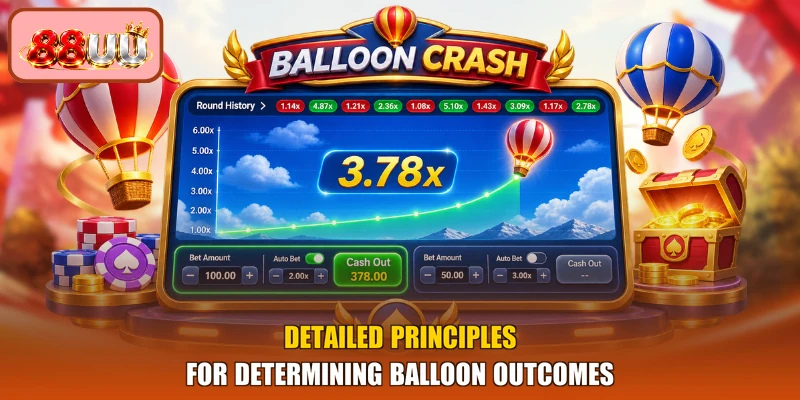
88UU has integrated several features into the Balloon game interface to make the process more convenient. These tools allow members to set certain actions in advance rather than relying entirely on a manual response during a fast round. Members can review the available controls and selected settings in the interface before each new round begins.
● Automatic cashout: Players can preset a target multiplier, such as 1.50x or 2.00x. When it reaches that level, the system automatically submits the cashout. This is intended to reduce delays caused by network transmission or hesitation. Set the target before the round begins and check that the feature is active.
● Dual betting: This feature allows a player to place two separate bets in the same round. Each position is treated independently, so members should review the stake and cashout settings for both before starting.
Tips and Strategies for Playing Balloon
Luck plays a major role in online crash games, but relying on it alone can quickly deplete an account. The source recommends combining practical approaches with careful bankroll management. The suggestions below describe different cashout targets and ways to handle risk. They are approaches, not guarantees, because every burst point is random.
● For Balloon, cash out early at a lower multiplier (1.2x–1.5x): This approach aims to build smaller returns over several rounds. The source describes it as a more sustainable option, particularly for beginners or members who want to protect their available bankroll. Although each payout may be limited, choosing a lower target can help keep a session shorter instead of waiting for a high multiplier. A loss is still possible if it bursts before the cashout is registered.
● Consider a higher target only if you understand the additional risk: Players seeking a more aggressive approach may wait for multipliers such as 3.0x or 5.0x. However, it can burst before either target is reached. The source describes combining this approach with dual betting: use a smaller position to pursue a higher multiplier rather than committing the entire bankroll to the riskier option. Set a limit in advance and do not increase the stake to recover previous losses.

Conclusion
Balloon is a crash game that combines a simple interface with quick rounds and a multiplier that rises until it bursts. Members should understand the mechanics, choose a cashout point, and manage their budget carefully. The RNG determines the burst point randomly, so no timing method can guarantee a win. Review the rules and features before taking part, set limits that fit your circumstances, and stop when those limits are reached. A careful approach may make a session controlled, but it cannot eliminate the risk of losing a stake.
